
Europe 2022
The Flywheel Effect Creates Space for Innovation
Creating confidence in the technology team is critical at every company. The flywheel effect occurs when we balance business strategy (via Wardley mapping) with technology strategy (via Modern cloud).
As a preview of the upcoming IT Revolution book, Dave creates a Wardley Map to show how to use the value flywheel to build confidence, improve your cloud stance and create space for innovation. Many business leaders ask for Innovation and speed, but it’s really Problem Prevention (Well-Architected), Modern Cloud and good Developer Experience that unlock higher value capability.
DA
David Anderson
Bazaarvoice, Technical Fellow
MO
Michael O'Reilly
Software Architect, Globalization Partners
Chapters
Full transcript
The complete talk, organized by section.
Host Intro (Gene Kim)
Thank you, Brody and Jane.
Okay, for at least three years, I've heard so much about some amazing work being done by a bunch of renegade engineers at Liberty Mutual, a large American, mutually held insurance company.
By all accounts, these engineers, who are based in Ireland, were among the first in the organization to get real applications running in the cloud using technologies very different than the ones typically found in a risk-averse enterprise those days. But they eventually would help elevate the productivity of over 6,000 technologists at the firm.
Not only did they help modernize the technical practices across the organization, starting with their e-commerce site, they also helped create the AWS Cloud Development Kit serverless patterns, which was widely adopted not just within the company, but across the industry, even being heavily promoted by AWS themselves. It was made popular because it made writing serverless applications so easy and understandable for developers.
So last year, I finally got to meet some of the people behind this effort who were leading a team of over 500 engineers in Belfast, Ireland. I was so excited to finally meet him, especially since he was introduced to me by none other than Adrian Cockcroft, who wrote this amazing, gushing introduction letter. And I am so delighted that they will be codifying their learnings into a book that will be published next year called The Flywheel Effect. So here are David and Michael.
David Anderson
Thanks, Gene.
So my name's Dave Anderson. I'm a technical fellow for Bazaarvoice. The story I want to tell you is really about space for innovation, how we made that journey from the last few years until today. I'd like to introduce my colleague here.
Michael O'Reilly
Hi, everyone. I'm Michael O'Reilly, an architect with Globalization Partners.
David Anderson
So myself, Michael, and our third amigo, Mark McCann, working together probably from about 13 or 14 years ago, and back in Liberty Mutual at the time, we were working on a lot of e-commerce sites, big systems, but on-prem.
And we were really lucky to be in a position in Liberty Mutual where the move to the cloud was starting, and this was back maybe in 2013. I had just took a CTO role in Belfast, and I had a small team of architects. And we started to look at the landscape, and we could see there was opportunity for huge change in a Fortune 100 company. This is an opportunity you don't get every day.
So we broadly mapped out what we thought might happen, and it was clear that there was a different cloud application architecture approach that we could take. Huge risk. It turned out to be serverless. We didn't know that's what it was. We didn't really know if this actually made sense. Massive personal risk. With any big risk like this, a lot of middle-management pushback says, "Why are you doing this?" We had the conviction to press on.
It was almost like a poker game where you can see there's one hand that's going to pay off big, but you have to play it.
So we started to bring in some of these practices like serverless, Well-Architected engineering, secure by design, all these things that were to become very good practice, but at the time, we didn't really know. This diagram was something we drew out at the time to try and make sense of this thing we were trying to do, this sort of almost like a system we were trying to create within a huge organization to basically reimagine engineering for the whole enterprise. A massive ask for what I would call a small office sitting in Belfast.
About 2019, 2020, we had achieved a huge amount of success with this serverless-first strategy. We actually started to coin it a serverless-first enterprise. The network effects that we were starting to see were starting to come true, and all the weak signals that we had seen back in 2013 were starting to kick in. And like anything, the numbers didn't lie. We were starting to see massive returns on some of the risks that we had played off maybe back in 2014, '15, '16.
And I put this diagram together to try and explain what we had actually achieved, because it was so difficult, because cloud application architecture is so hard to describe. And once I drew this diagram, I actually called Adrian Cockcroft from AWS. I showed him this diagram and said, "Do you think this approach makes sense? Because I haven't seen it anywhere else." And he said, "No, this is absolutely brilliant. You're leading the way with the way you're thinking here." And to say the least, I was shocked.
So we described it in four layers. Foundational was basically our key engineering approaches, which are kind of bread-and-butter stuff. Then we want to layer in our cloud expertise, security, infrastructure as code, and certification. Then have an opinion: be opinionated about architecture, serverless-first to be Well-Architected, focus on cost, have an organization strategy, have a clear North Star business metric, and then organization team topologies, be organized for success. And then find acceleration. How do we scale that across 6,000 engineers with CDK architecture patterns, specific innovation practices, evolutionary strategy, encourage teams to pave their own way? Code is a liability. Try and get engineers to write less code. And then evolutionary architecture. Try and get the concept into the business that we are always changing these systems, which is quite difficult.
There's lots of really good stories out there about Liberty Mutual. I would actually Google Liberty Mutual serverless. There's a whole bunch of case studies.
Michael, you were there those years. What stands out for you in this picture?
Michael O'Reilly
Yeah. No, thanks, Dave. I love this diagram. It brings back some awesome memories.
But certainly, for me, I always go back to the foundational because I think that really set us up for a lot of the success that we went on to achieve. Working with the teams, helping the teams really become data-driven and, by that, understand what measures were important to them, both from a business perspective and also from a technical perspective. How are they able to add value? So when you enable your teams to understand their mission and their purpose through the data, it then makes a lot of these other things easier to integrate and drive within the organization.
For example, I know we're going to look at serverless-first org strategy. So this is a building block that was within the diagram. And really, we coined this because obviously we were operating at scale. We're a large organization. We've got dozens and dozens of squads, product squads, different types of squads. But we tried to distill that down into something that would fit into teams' heads.
But really summing it up, this is the metrics that we use to help create teams that maybe didn't understand their purpose or their mission, and maybe working on non-differentiating type work or work they didn't understand, to become teams that really understood their mission and purpose, had good situational awareness, and were able to make good decisions in terms of the products and features that they were able to then go and build and develop, leveraging that serverless-first organizational strategy.
David Anderson
Yeah. And remember, serverless-first, that was important because you have engineers at an insurance company. Their focus should be insurance. It's the business. So I'm so proud of some of the outcomes that we drove. One of the ones that I thought was amazing was a call transaction cost. We ended up building a complete cloud call center using serverless technology, using on AWS, like Connect and Lambda and a bunch of other services. And we reduced the cost of a call from $20 down to $0.04. And by about a year and a half ago, I think they were taking something like a quarter of a million calls per month on that, as a purely serverless automated call center.
Michael O'Reilly
Yeah. And for me, I know we've got a callout here that's the second point, but the rapid delivery. There was a scenario I remember just when the pandemic kicked in, and effectively we had a business use case in South America where our agents had to go and visit the homes of potential customers. If they were trying to insure their car, they needed a manual inspection. Obviously, with the pandemic, that became much more difficult, and obviously there were issues with that. But leveraging our serverless-first org strategy, we were able to assemble an application that was leveraging artificial intelligence to automate that process and build a product that could protect both our agents and our customers and move that process digital.
Also, that was an innovation in a sense, and we were able to then roll that out to subsequent countries over the next three to four months. And I think we rolled that from South America six countries wide, and then we moved that into Europe. So hugely successful story with that one.
David Anderson
And then the digitization of the business is really what you're talking about here. And one of my favorite stories that I'm also super proud of is the fact that we had one, and insurance has thousands of applications for a big company. We had one small application that was sitting on WebSphere. I think it was costing maybe $50,000 a year to run. One of the teams seen that as an opportunity, refactored it to a serverless solution, and reduced the cost from $50,000 a year down to $20 a year. And think of the sense of empowerment that those engineers have by a nice project like that.
Michael O'Reilly
Absolutely phenomenal. Phenomenal. And I think even on the smaller scale, it was really successful, but even again, on the larger scale, we applied this strategy to some of our largest insurance platforms. I remember our global insurance platform that we rolled into Europe, and it was driven a large part by our serverless-first org strategy, was able to help the org move at scale as well and drive scale into the business, which was fantastic. Really successful.
David Anderson
And then there's also a whole big story about the journey the engineers went on to work through this kind of system that we created and really excel. At one point, I think I had four AWS Heroes on my extended team. Very few companies even have four Heroes. We had Gillian McCann, Gillian Armstrong, Matt Coulter, and Tom McLaughlin. And then there's a whole bunch of people as community builders as well. So these are engineers that have done fantastic pieces of work, doing keynotes, big presentations for AWS. Gillian McCann took Workgrid as a project and spun that out into a complete startup, its own separate company. Massive success stories here with people focusing on the business outcome and using serverless to go fast at high quality and at scale. So proud of the work we did there.
What we were almost seeing then was AWS started to take notice of the success we were having. And back in 2020, there was a Serverless First Function event where, and I didn't know this, Werner Vogels, the CTO of Amazon, actually described Liberty Mutual as organizational nirvana because of our serverless-first cloud application architecture approach. I almost fell off my chair watching this at home.
And then six months ago at re:Invent, Matt Coulter, one of the architects, he did the keynote with Werner Vogels to tell the Liberty Mutual story, which was an unbelievable presentation. I was so proud watching Matt. I was in the front row cheering him along. And he told this brilliant story about the whole evolution for Liberty Mutual becoming a serverless-first enterprise. And one of the things that we did was we codified a lot of our patterns and created this CDK pattern library to help developers create their applications really fast. And now that's been open sourced, and that's its own open source project itself. And Matt has been fantastic in leading that community with CDK Day and a whole bunch of other stuff. So not only have we created building blocks to build applications that have been shared out, and I think there's something like 5,000 people on that GitHub repository. It's absolutely huge.
Michael O'Reilly
Phenomenal story.
David Anderson
Yeah. So that creates a flywheel effect where engineers start to see the success and start to learn more and see the feedback in their community, getting really good kudos with all engineers. So then we kind of stepped back and said, "We've stumbled across something here that's a fantastic technique. Let's try and distill all this thinking into a book," which we're publishing with IT Revolution this November, called The Flywheel Effect, with myself, Mike, and Mark putting this book together. And really it's about how do you take your business strategy with Wardley Mapping and your technology strategy with modern cloud and combine them together, and what does that flywheel effect look like? So we talk about this in the book and get into the thinking and some of the theory about how we, and the practice and the success stories of how we actually made this happen and how to do this yourself.
So really one of the questions that I found fascinating as I think about other companies is what happens after the transformation? Now we've had the hullabaloo around, "We're going to the cloud, digital transformation." What happens when all the consultants have been paid? We've did our three or four years. The big bonus pot's been emptied. Everyone's gone out and bought their cars and boats, et cetera. Everyone's got cloud socks. They've come back from the conference. We're all high-fiving each other.
Michael O'Reilly
Mm-hmm.
David Anderson
At some point, the board or the CEO goes, "Okay, we've spent a whole bunch of money going to the cloud. Why are we not delivering faster?" It's a great question. And really the question is, is technology really driving your business? Because there is a culture change required. In this event, we've talked with the DevOps culture for many years, and that is that cultural change that needs to happen.
Just lift-and-shifting to the cloud just gives you a nicer data center. You're not really benefiting from the cloud. And one of the ways we sort of started to describe this is this idea of modern cloud versus legacy cloud.
If you just lift and shift what you have, you've got legacy cloud. You maybe still have a monolith in the cloud. You maybe still have a lot of EC2's virtual images. Maybe you're logging and changing stuff. You don't have that automation.
With modern cloud, you're thinking and behaving differently. You have a very small time to value. You can prove value quickly. You can use the latest techniques, and you've got that empowerment and really strong developer experience. We think this way of acting differently is the actual massive success factor for modern cloud.
Michael O'Reilly
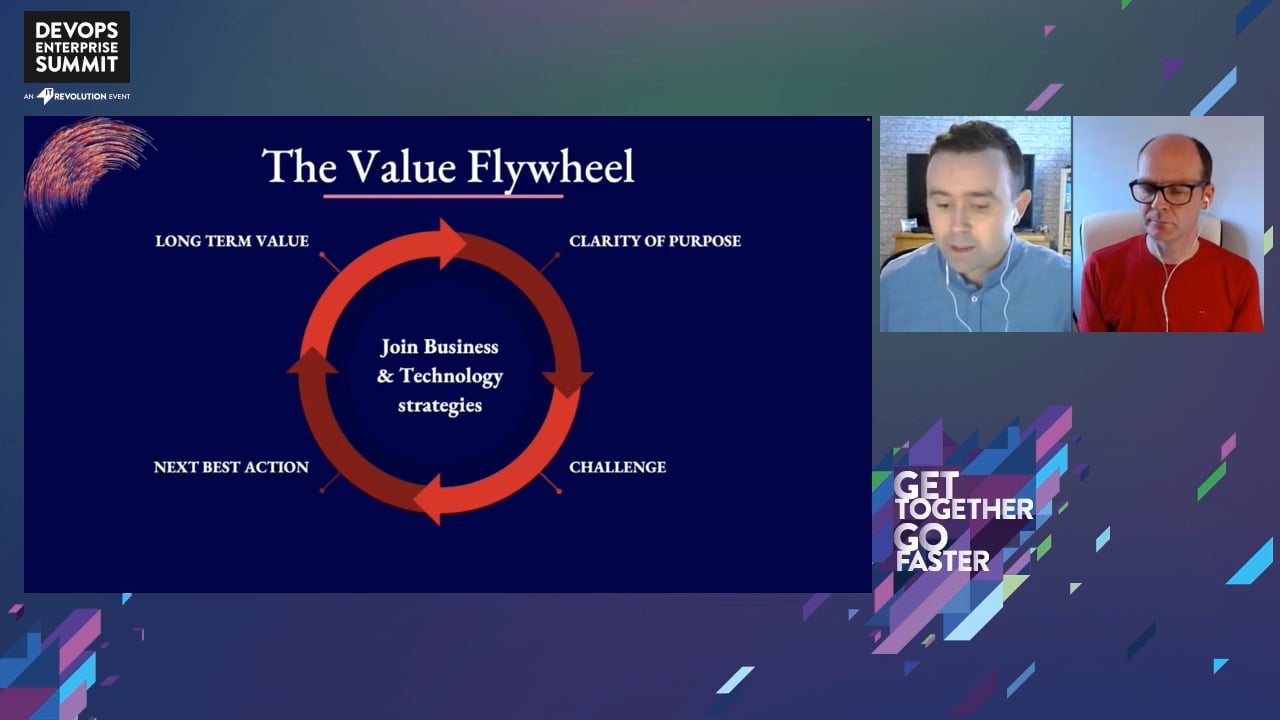
Yep, Dave. And when we talk about the flywheel, and the flywheel as we've described it here, is how do we create a flywheel? How do we create that movement and progression within our organization? And this is the flywheel that we talk about within the book.
So we start off with really trying to understand our purpose. We create an environment that supports challenge and psychological safety around challenge, in terms of really getting to understand that purpose. Then we leverage situational awareness to decide on next best action. What's the next best action for us to take? And then also, regardless of what the next best action is, we've always got to keep an eye on the long-term value.
And Dave, taking us back into Wardley Mapping. Wardley Mapping helps us always have those conversations. It helps with the challenge. It helps with that situational awareness. It helps us always keep an eye on what's our purpose, but it also can help us drive and make sure that we're working towards that long-term value. So we're going to get into that, I think, in our Wardley Mapping session.
David Anderson
Yeah. So some of you may not be aware of Wardley Mapping, but we're going to take you through how we as an architecture team have used this technique to actually visualize some of the things we're trying to do in this value flywheel to kind of drive that change we had talked about earlier.
So anytime you're starting a Wardley map, the best way to start this is with a value chain. So we've picked out a persona here as the anchor, as a senior leader. This is likely a CEO or maybe someone on the board, a very senior leader in your organization. And for me, there's two main value streams that that senior leader is looking at when they think about technology. First is time to value. Right? Not lead time, time to value, which depends on good architecture, I would say Well-Architected. And good architecture depends on technical leadership. These are just straight dependencies within your organization.
And then a second kind of customer need for that senior leader is innovation. So for me, innovation depends on modern cloud, and modern cloud depends on a strong team environment. So it's how is your engineering environment set up.
Mike, have anything you want to add about these value chains?
Michael O'Reilly
Well, the thing is, why I would ask the question is how do we know they're right? And the answer is, well, we don't, but it helps us get out of that analysis paralysis and helps us really get into that conversation. But then I think applying mapping and the approach to mapping helps us apply a wee bit more meaning and a wee bit more understanding to that conversation.
David Anderson
If I was doing a Wardley map, I would do these pretty quickly. I would use something fairly simple and just lay them out as a five-, 10-minute exercise.
So here we've got the shape of the map here. As you can see, we've kind of got business growth in the top left there. We've got Well-Architected on the right, and the environment success is that kind of key enabler.
So let's go back to the start and actually draw this map out again. And I think what's important here is, as an architecture team, you need to know what you invest in and what we don't invest in. What do we need to improve as an architecture team, and what else do we not touch? So something like operational excellence, we know how to do operational excellence. As a senior leader, there is a specific need there. It's understood. Job done.
Mike, what do you think about this one?
Michael O'Reilly
Yeah, 100% agree. And if we're following practices and standards around operational excellence that aren't commodities, what are they and why are we doing them? So that's a good conversation. Pretty simple.
David Anderson
The other two, time to value is probably more, we understand it well, and we understand there's key things like observability and customer obsession that are important there. For business growth, it's a bit more kind of a hypothesis. We're still trying to understand better about how do you actually get that business growth.
Michael O'Reilly
Yeah. It should always be custom. It should always be custom. And then I love here out in the left, you've got sustainability coming in in the genesis space. How is that going to affect what we do? Sustainability is impacting industry in a big way. Cloud providers are allowing us to measure our carbon footprint. It is going to have an impact. What is that impact? Let's have a conversation. What could that be?
Again, as architects, we want to figure out where we're being most effective. And for me, I thought when Dave went through this, it's around that developer enablement, developer experience. How can we have a modern tech stack that we can experiment and learn, which includes the foundational block here is modern cloud.
David Anderson
Absolutely. So you can see in here that developer enablement is a huge component of our ability to modernize, and it does feed back up into time to value. So really, what are we doing as a technical leadership squad to really enable our teams and focus on developer experience and developer enablement? So that's a huge factor in our map. And you think of the major cloud providers, this is where they're focused on right now, and there's good reason for that.
Other things like Well-Architected, both Amazon, Google, and Azure have really, really solid Well-Architected frameworks that are maybe eight, nine, 10 years old. We know what good architecture looks like. Just follow the guidelines. There's no custom good architecture practices. They're very well understood. And then we can codify those in cloud architecture patterns.
Michael O'Reilly
Absolutely, and Well-Architected gives us that commoditized set of architectural standards that allows us to create patterns consistently across the whole organization. So when we do enable our engineers by putting it into that cloud self-service portal, they're all really consistent. They're all working to the same set of enabling constraints. So as an architect, I love that stuff.
David Anderson
Yeah. And adopt a standard. Don't write your own. You are not different.
And then finally, growth mindset. If you're going down this route, you need to have technical leaders who are willing to change, experiment, and engineers who are willing to try new things. So that growth mindset is so important.
For us, Wardley Mapping is that hypothesis that we could maybe map things out and understand what we need to do and what we don't need to do. And then psychological safety is that idea of it's our role to try and create that for the teams. Give the teams space to learn.
Michael O'Reilly
Completely agree. And in a diverse sort of cultural environment such as a big corporation, extremely important. How do you get everyone's ideas? How do you get them involved in that modernization process? How do you create a space where people want to come and be creative? Super important part of the map.
David Anderson
So you see how complicated this whole picture is, but what we have found is drawing this out like a map enables that conversation and challenge to try and get everyone on the same page.
But let's shrink this back down and really see the shape of it again. Again, you want to tie the senior leader needs right down to what the architecture team can do to what we need to do within the engineering teams. That's the kind of chain here that we're trying to reflect here. And then from a modern cloud, this is probably the unknown piece that we need to move to the right to modernize.
Michael O'Reilly
Absolutely, Dave. And we talked about CDK patterns as being really a massive part of that serverless-first org strategy. So we were investing quite heavily in embracing modern cloud. How do we get modern cloud into every part of the organization? Well, our strategy is evolving around developer enablement, that cloud self-service, those patterns that are built on Well-Architected. We planned to shift that from being built as a custom component in one part of the org, but make it the de facto. That's our modern cloud strategy for the whole organization. So that, again, important part of movement.
And we also talked about sustainability as being a climatic pattern that is beginning to penetrate the map there in terms of the business growth area. So you can see you're already starting to see movement within the map and having to deal with that movement.
David Anderson
And then that takes us as we talk about the book, The Flywheel Effect. We start to see the Value Flywheel reflected here in the map. And number one was the customer need there with clarity of purpose is that first part of the flywheel. Number four, as architects, we've got Well-Architected as that's our kind of long-term value. But the difficult things to do are number two and three as two parts of the flywheel. How do we create an environment for success where we can challenge thinking? And how do we introduce a next-best-action kind of mindset that we can act quickly and kind of go with that modern cloud, which will get you to that kind of Well-Architected long-term value.
Michael O'Reilly
Absolutely. And this was the flywheel effect in action for us. We've kind of talked about it briefly already, but even we look at that challenge in landscape area, types of things that we were doing was looking at replication across all our squads and our environments and our teams. What could we do to address that? How could we reduce our costs? What is our next best action? How could we take actions and apply strategies to move that modern cloud practice from custom build into that product for our organization? So again, the flywheel effect is very, very real in this scenario.
David Anderson
And remember, the map drives conversation.
So really the four phases there, again, we've got them here in the Value Flywheel in the book with the clarity of purpose, which is that North Star and that time to value; challenge, that environment; next best action, your developer experience and serverless-first, your modern cloud strategy; and then long-term value, which is your problem prevention culture, Well-Architected, sustainability. This is this concept of joining your business strategy with your technology strategy. And again, this is what we're talking about in the book, and we explore this with great detail and examples in the book.
So thanks very much for listening.
Here's the help we're looking for, as Gene has asked us to give our callout. The book is there for pre-order on Amazon, and you can see there it's out in November. What I'm really interested in, and I'm very happy to continue the discussion on Slack or on Twitter: are you seeing this modern versus legacy cloud split? I see a lot of both modern and legacy cloud, but I haven't seen it really be named in this way yet.
Do you see this flywheel in your organization? I've seen this in lots of organizations, but I'm looking for more examples that we can really kind of understand this and help people through this. Have you looked at Well-Architected and sustainability? For me, the Well-Architected frameworks are absolute gold, but I don't see the adoption that I think there should be there.
Have you tried Wardley Mapping and sense-making and technical discovery within your architecture teams and technical leadership teams? A lot of people are afraid of Wardley Mapping, but a lot of people have got massive success. How can we lower the bar to entry and help leaders actually map out their landscape and drive forward? I don't know about you, Mike, but it'd be great to hear people's opinions and continue the discussion.
Michael O'Reilly
Yeah. Be awesome.
David Anderson
Brilliant. So that's us. So we have more, like I said, the book's coming out in November with IT Revolution, and it's been a great experience writing the book. We also have a blog there at TheServerlessEdge.com, and we have our Serverless Craic channel and podcast. Look us up on Twitter there, and please reach out to us on Slack on the DevOps Enterprise channel. I'm happy to keep the conversation going. So thank you, Gene, for the kind introduction. Thank you.
Michael O'Reilly
Thanks.